
 Available in GB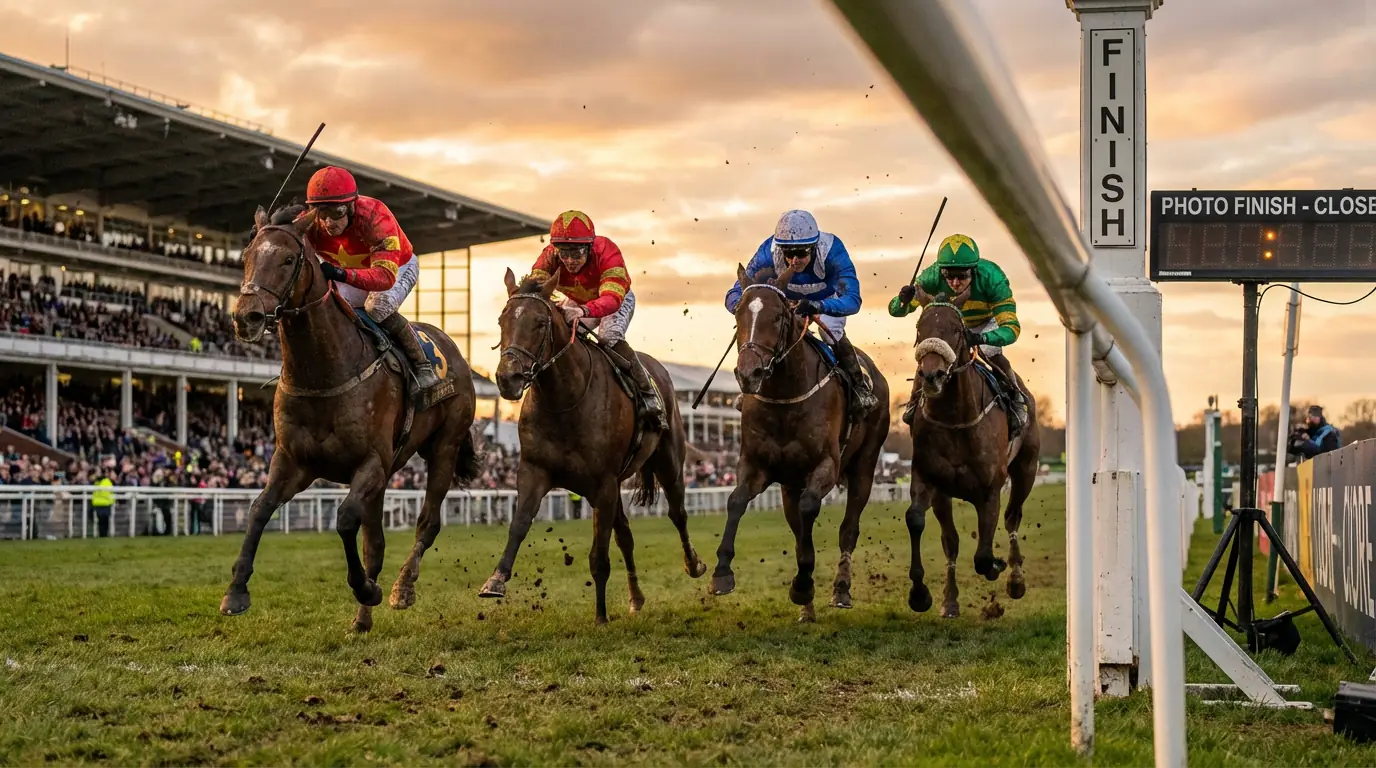
Two Bets in One
An each-way bet is not one bet. It is two. The first is a win bet: your selection must finish first for this part to pay out. The second is a place bet: your selection must finish in the places (typically the top two, three, or four, depending on the event) for this part to pay out. Both bets are for the same stake, which means an each-way bet costs twice what a win-only bet at the same unit stake would cost. A £5 each-way bet costs £10 total — £5 on the win and £5 on the place.
If your selection wins, both parts of the bet pay out: you collect the win bet at full odds and the place bet at a fraction of the odds (the place terms). If your selection finishes in the places but does not win, the win bet loses and the place bet pays out. If your selection finishes outside the places, both bets lose. The structure provides a partial safety net: you can lose the race but still make money if your horse, golfer, or greyhound finishes close enough to the front.
Each-way betting originated in horse racing and remains most closely associated with it, but the format is available across multiple sports on UK betting sites. Golf tournaments, greyhound racing, motor racing, and some outright markets in football and darts all offer each-way terms. The place terms vary by sport and by the number of competitors, which makes understanding the specific terms of each bet essential before you commit your stake.
The appeal of each-way is its dual nature. You are betting to win, but you have a fallback. This makes it particularly attractive for longer-priced selections in large fields, where the probability of winning is low but the probability of placing is meaningfully higher. A 20/1 shot in a twenty-runner handicap has roughly a 5% chance of winning but perhaps a 15-20% chance of finishing in the top four. Each-way allows you to capture value from that broader probability without abandoning the chance of a full-price win.
Place Terms and How They Work
Place terms define how many positions count as a “place” and what fraction of the win odds you receive for a placed finish. The standard terms in UK horse racing are set by convention and tied to the number of runners in the field.
In races with five to seven runners, the standard place terms are first and second at 1/4 of the win odds. In races with eight or more runners (non-handicaps), the places extend to first, second, and third at 1/5 of the win odds. In handicap races with sixteen or more runners, the places extend to first, second, third, and fourth at 1/4 of the win odds. These are the standard industry terms, though some bookmakers may offer enhanced place terms as a promotional feature — paying four places on a non-handicap, for instance, or extending to five places on large-field handicaps.
The fraction matters considerably. At 1/4 of the odds, a horse priced at 10/1 has a place price of 10/4 (or 5/2). At 1/5 of the odds, the same horse has a place price of 10/5 (or 2/1). The difference between 5/2 and 2/1 is significant over repeated bets. In handicaps with 1/4 odds, the each-way place return is more generous than in non-handicap races with 1/5 odds — one of several reasons why experienced each-way bettors gravitate toward large-field handicaps.
In golf, each-way terms are typically 1/4 or 1/5 of the odds for the top five or top six finishers, depending on the size of the field and the operator’s terms for that specific tournament. Greyhound racing, with its standard six-runner fields, usually pays two places at 1/4 of the odds. The key habit to develop is checking the specific place terms for every each-way bet you place, because they vary by event and by operator, and the terms directly determine the value of the bet.
Some bookmakers offer “extra places” promotions on selected races, extending the number of paid positions beyond the standard terms. A race that normally pays three places might pay four or five under an extra places offer. These promotions are valuable in large-field handicaps, where the fourth or fifth horse home was a fraction away from a standard place anyway. Extra places offers effectively reduce the risk of each-way bets and should be factored into your operator selection if each-way betting is a regular part of your approach.
Calculating Each-Way Returns
The arithmetic is straightforward once you know the components. You need three numbers: the win odds, the place fraction, and the stake. The win part is calculated as you would any standard bet. The place part uses the odds divided by the place fraction.
Example: a £5 each-way bet (total stake £10) on a horse at 12/1 with place terms of 1/4 the odds, placing three. The place odds are 12/4 = 3/1. If the horse wins, the return is: win part = (12 x £5) + £5 stake = £65; place part = (3 x £5) + £5 stake = £20. Total return: £85. Profit: £85 minus £10 total stake = £75.
If the horse finishes second or third (placed but not winning), the win part loses (minus £5) and the place part pays out: (3 x £5) + £5 = £20. Total return: £20. Profit: £20 minus £10 total stake = £10. You have not won at full odds, but you have made money.
If the horse finishes outside the places, both parts lose. Total return: £0. Loss: £10.
The critical number to calculate before placing an each-way bet is the place-only profit — the return you receive if the selection places but does not win. In the example above, a place-only finish returns £10 profit on a £10 total stake. That is a 100% return on stake from a placed finish alone. At shorter odds, the place-only profit can be marginal or even negative. A horse at 4/1 with 1/5 place terms has place odds of 4/5. A £5 each-way bet that places but does not win returns (0.8 x £5) + £5 = £9, against a total stake of £10. You make a net loss of £1 even though your horse placed. This is the fundamental each-way trap at short prices: the place part does not cover the cost of the losing win part.
The breakeven point — the price above which each-way betting on a placed horse returns a profit — depends on the place fraction. At 1/4 odds, the breakeven is approximately 5/1. At 1/5 odds, it is approximately 5/1 as well, though the profit at that price is thinner. Below these thresholds, an each-way bet on a horse that places but does not win is a net loser. Above them, you profit from a place alone. This arithmetic should guide every each-way decision you make.
When Each-Way Beats Win-Only
Each-way betting delivers superior value in a specific set of circumstances: large fields, long prices, and place terms that make the place portion independently profitable. A twenty-runner handicap at Ascot with a selection at 14/1 and 1/4 odds place terms is the natural habitat of the each-way bet. The place odds of 14/4 (7/2) offer a genuine standalone return, the field size extends the places to four, and the volatility of the race means that a horse can finish in the frame without needing to beat the best in the field.
Conversely, each-way betting at short prices in small fields is almost always worse than a win-only bet. A 3/1 shot in a six-runner race, with places paying only first and second at 1/4 odds, has a place price of 3/4. The place portion barely breaks even on a placed finish, and the doubled stake means you need the win to justify the extra outlay. In these situations, a win-only bet at the same stake produces a better expected return.
Golf is another sport where each-way betting frequently delivers value. Tournament fields are large (typically 144 players), each-way terms usually pay the top five or six, and the range of prices is wide. Backing a golfer at 40/1 each-way in a major championship gives you place odds of 10/1 or 8/1 for a top-five or top-six finish. The probability of a top-class golfer finishing in the top six is significantly higher than the probability of winning outright, and the place return alone can be substantial.
The general principle is this: the longer the price and the more places available, the more the each-way structure favours the bettor relative to a win-only approach. At short prices in small fields, win-only is almost always the correct choice. The threshold is not fixed — it depends on the specific odds, the specific place terms, and the number of runners — but the 5/1 to 6/1 range is a useful mental marker. Below that, think win-only. Above that, consider each-way.
The Safety Net
Each-way betting is not a strategy for the cautious. It is a tool for punters who have assessed a selection’s probability of placing as well as its probability of winning, and who have determined that the combined structure offers better value than either component alone. The safety net is not free — you pay double the stake for the privilege — and it only works when the place terms are generous enough to deliver a meaningful return on a placed finish.
The best each-way bettors are the ones who think in terms of the place bet first. They ask: is this horse a good bet to finish in the top four at 7/2? If the answer is yes, the each-way bet is worth placing, because the place component alone offers value. The win component is the bonus — the additional upside that costs nothing extra beyond the original decision to bet each-way. Framing the bet this way — place first, win second — avoids the common trap of backing long shots each-way purely for the dream of the win price, without considering whether the place part justifies the total stake.
The safety net has a cost, and it has conditions. Use it in the right races, at the right prices, with the right place terms, and it is one of the sharpest tools in the punter’s kit. Use it indiscriminately, and it is just a more expensive way to lose.